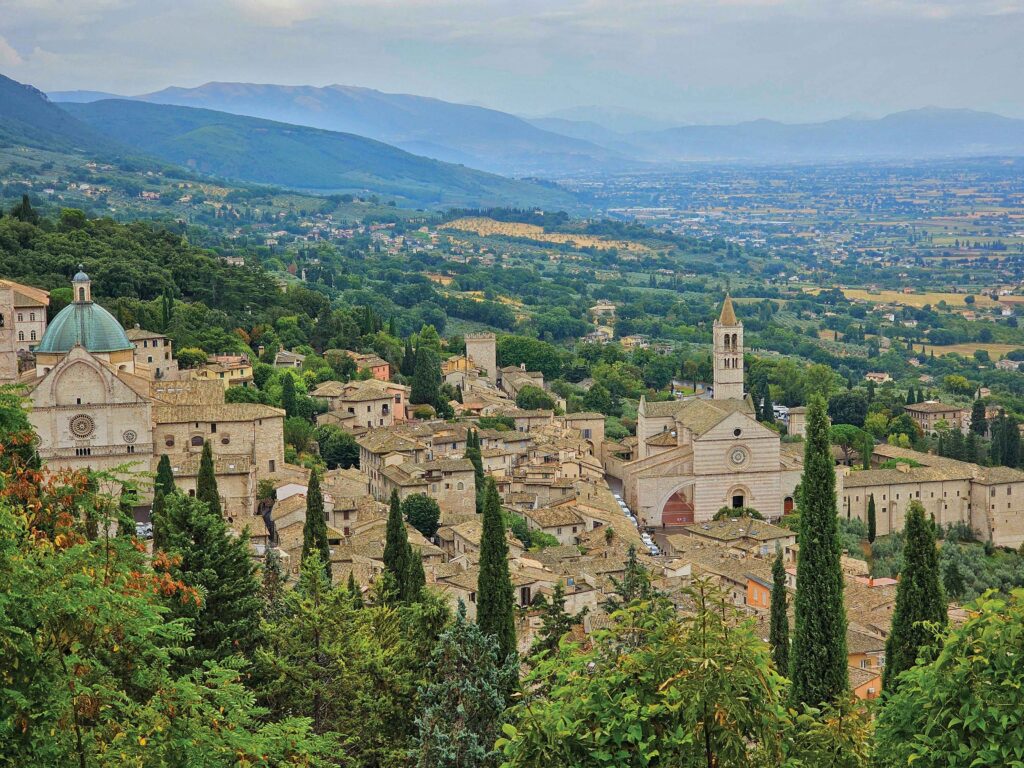
A Journey to the Heart of Franciscan Italy
Perched on the slopes of Monte Subasio in the green heart of Umbria, Assisi is one of those rare places where history, faith, and landscape converge into something genuinely moving — even for the secular traveler. Best known as the birthplace of Saint Francis, the town draws millions of pilgrims and visitors each year, yet manages to hold onto an atmosphere of quiet contemplation that feels almost miraculous given the crowds.
Getting There
Assisi is easily reached by train from Rome (around 2–2.5 hours, changing at Foligno) or Florence (about 2 hours). The nearest station, Santa Maria degli Angeli, sits on the plain below the hilltop town, with regular buses and taxis connecting the two. If you’re driving, the town is well-signposted from the SS75. Plan to park outside the old walls — the centro storico is largely pedestrian.
The Basilica of San Francesco
This is the undisputed starting point for any visit. Built in the decades immediately following Francis’s death in 1226, the basilica is actually two churches stacked on top of each other — the dimly lit Lower Church, richly decorated with frescoes by Cimabue and Pietro Lorenzetti, and the brighter Upper Church, whose nave walls were famously painted by Giotto with scenes from the life of Francis. Below both lies the crypt where the saint’s remains are interred. Arrive early — by mid-morning, coach groups fill the nave. Dress modestly: shoulders and knees must be covered.
The Life of St. Francis — and Why It Still Matters
Giovanni di Pietro di Bernardone was born here around 1181 or 1182, the son of a wealthy cloth merchant. His early life was comfortable and sociable; by his twenties he had experienced military captivity, illness, and a gradual spiritual awakening that led him to renounce his inheritance publicly in Assisi’s main piazza. He embraced radical poverty, care for lepers, and a profound reverence for the natural world — themes captured in his famous Canticle of the Creatures, one of the earliest works of Italian literature.
After a dispute with his father, Francis publicly renounced his inheritance and possessions.
He attracted followers with his simple, joyful life, focusing on preaching and living without property. In 1209, he and his 12 followers gained informal approval from Pope Innocent III.
He inspired St. Clare of Assisi to found the Poor Clares, a cloistered order committed to the same poverty.
The Franciscan movement he founded went on to reshape medieval Christianity. Walking the streets of Assisi, it’s possible to trace almost every stage of that story.
This year marks the 800th anniversary of his death and has been named a jubilee year by Pope Leo commemorating the anniversary. Special events are planned throughout the year.
Key Sites Beyond the Basilica
The Piazza del Comune sits at the center of the old town and is worth a long pause. The Roman Temple of Minerva — its columns still standing, now a small church — is a reminder that Assisi was a thriving Roman settlement long before Francis. Nearby, the Museo Civico holds Roman finds from the forum beneath the piazza.
The Eremo delle Carceri, a hermitage set into the wooded hillside of Monte Subasio about 4 kilometers from town, is one of Assisi’s most atmospheric spots. Francis and his early companions retreated here to pray in the caves among the oaks. The walk up through the forest is lovely, and the site itself is surprisingly peaceful even in season.
Down on the plain, the vast Basilica of Santa Maria degli Angeli encloses the Porziuncola, the tiny chapel where Francis founded his order and where he died. The contrast in scale — a Baroque basilica built around a chapel barely large enough for a few people to stand in — is quietly astonishing.
Practical Notes
Assisi rewards an overnight stay. Once the day visitors leave, the town takes on a different quality: the pink stone of the buildings softens in the evening light and the narrow lanes grow still. There are good hotels in and around town at a range of price points. Umbrian food is hearty and unfussy — look for strangozzi pasta, local truffles in season, and Sagrantino wine from nearby Montefalco. Most major sites are free to enter; the Basilica of San Francesco has no admission charge, though donations are welcome. A good resource for lodging and fining is www.visit-assisi.it
A full day gives you time to cover the main sites comfortably. Two days allows for a slower pace, and the pleasure of just sitting in the piazza as the light changes.
St. Francis’ Legacy in Birmingham
The life and name of St. Francis of Assisi lives on in the city. In Bessemer there is a Catholic Church named after the saint. And there is also an Episcopal Church named in his honor, The Episcopal Church of St. Francis of Assisi in Indian Springs.