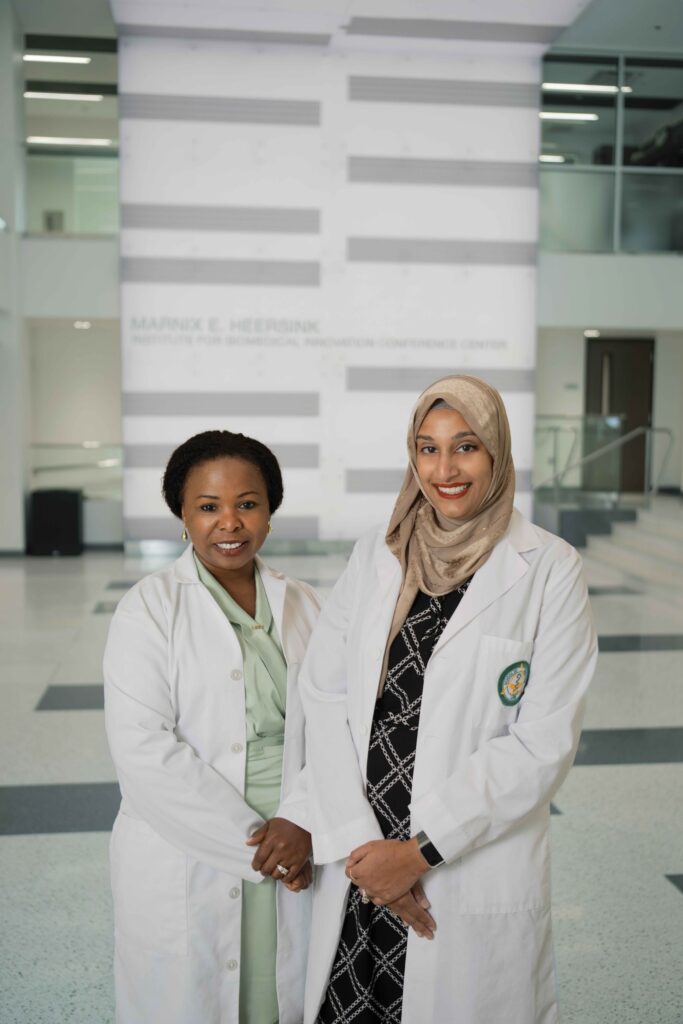
UAB’s Dr. Blessing Faola and Dr. Haniya Halim.
Based in Birmingham, Dr. Haniya Halim is a child and adolescent psychiatry fellow at the University of Alabama at Birmingham. She completed her training in general psychiatry at UAB in 2025 prior to entering fellowship, and is board-certified in general psychiatry. Her work centers on supporting children with early developmental challenges and those who have been affected by trauma, as well as adolescents struggling with psychotic, mood, and anxiety disorders. She is deeply committed to expanding access to community-based mental health services and hopes to help bridge gaps in psychiatric care across the metro Birmingham area.
Dr. Blessing Falola is the program director of the child and adolescent psychiatry fellowship program at UAB. She recruited Dr. Halim to this program from residency and has been a mentor in the field for several years. “She has encouraged me to find my niche in the UAB psychiatry community and is a role model for all fellows.” Dr. Halim says.
Working in child and adolescent psychiatry first occurred to Dr. Halim in high school and she pursued it in college with a growing interest in psychiatry and child development
As an adult psychiatry resident she encountered many adult patients with severe mental illness rooted in childhood or adolescence. These patients had mood or psychotic disorders, traumatic experiences, and inadequate or no treatment.
“My time with them reinforced the importance of early intervention to prevent mild illness from worsening. Serving as a role model and advocate for struggling adolescents also makes a difference.
Dr. Halim is aware of the national shortage of child psychiatrists and the growing need in many communities. “Many areas in Alabama lack psychiatrists within 100 miles,” Dr. Halim says, “With wait times exceeding 6 months to a year. Serving these families and helping children and adolescents in need motivates me,” she says.
According to Dr. Halim, Alabama, a regional hub for treatment, faces significant access challenges. It ranks last in the nation for mental health workforce availability, with only about 100 child psychiatrists serving a state with a population of 25% under age 19. This translates to one psychiatrist per 12,000-14,000 children, leading to long wait times, especially for specialized services like autism evaluations or trauma-focused therapy. Many counties lack child psychiatrists, with resources concentrated in cities like Birmingham, Huntsville, and Mobile.
Collaboration between primary care physicians and psychiatrists aims to address these issues. In metro Birmingham, primary care clinics can partner with adult and child psychiatrists to form integrated behavioral health programs. Primary care physicians can consult psychiatrists in the primary care setting, improving access by reducing wait times, travel, and stigma associated with mental health care, Dr. Halim says.
Yet work is being done to address these weaknesses. UAB psychiatry established three early intervention mental health clinics called TEAMS, which stand for Treatment, Evaluation, and Multidisciplinary Approaches. These clinics focus on treating psychosis, mood disorders, and substance use. “I’ve worked in all three clinics and can say we’ve treated many adolescents and young adults with these conditions who would’ve had to wait months elsewhere. Early treatment leads to better outcomes, so we’re actively working to improve access and awareness of these conditions,” Dr. Halim says.
“Success as a physician is multifaceted, with patient outcomes and satisfaction being key. Helping a struggling child with ADHD or preventing a teen from committing suicide or overdosing are positive outcomes. Psychiatrists also promote mental health in the community by providing education about seeking treatment and reducing stigma. Addressing the mental health workforce shortage is a priority, and mentoring students in various stages of training while encouraging them to pursue careers in this field is a direct and successful way to address it.”