by Perryn Carroll
As the Executive Director of the Jimmie Hale Mission, I regularly attend meetings filled with conversations about how to address the issues surrounding homelessness. The question always arises, what can we do to make a real difference?
Last summer, I began to wonder how I can speak with real understanding and seek meaningful solutions for those in need. It became clear that talking from a safe distance was not enough and never would be. To truly understand, and thus, truly bring answers to the problems, there had to be a willingness to step closer to reality and feel, even in a small way, the weight and hardship of homelessness so that compassion could grow from experience, not just intention.
With much prayer and reflection, I felt convicted to move forward with experiencing a slice of life more like those caught in homelessness. I made plans to spend the night alone, just like our neighbors, on the city streets and in the elements in downtown Birmingham. With little to rely on beyond personal resolve, the kindness of others, and God’s hedge of protection, my goal was to more closely experience the issues that so many just talk about.
Months in advance, we selected January 14th as the night I would spend on the streets. As that day approached, it was clear that I would have the opportunity to experience the brunt of our Winter weather. Early evening cold rain in 40-degree temps was followed by hours of wind gusts up to 28 mph and temps that fell into the mid-20s. The wind that cut through every layer of my wet clothing and made the temperature feel even lower.
Initially, I had only the clothes on my back. No coat, no hat, no gloves. To truly feel the vulnerability of those caught in homelessness’ grasp, it was important to me to honor the principle that, without the generosity of others, I would be unable to access basic essentials to survive. Beautiful gestures by Alabama Power employees, Canterbury United Methodist Church, and Jamie Warren from Iron Tribe Fitness made it possible for me to have a coat, hat, gloves, and a sleeping bag. Those basic items made all the difference against the cold, whipping wind. Beyond these clothing essentials, everyday things that so many of us take for granted: a bathroom, food, water, and basic shelter were all items I would be without. In fact, I stopped drinking anything by 11 am that morning knowing that there would be no bathroom facilities available that night.
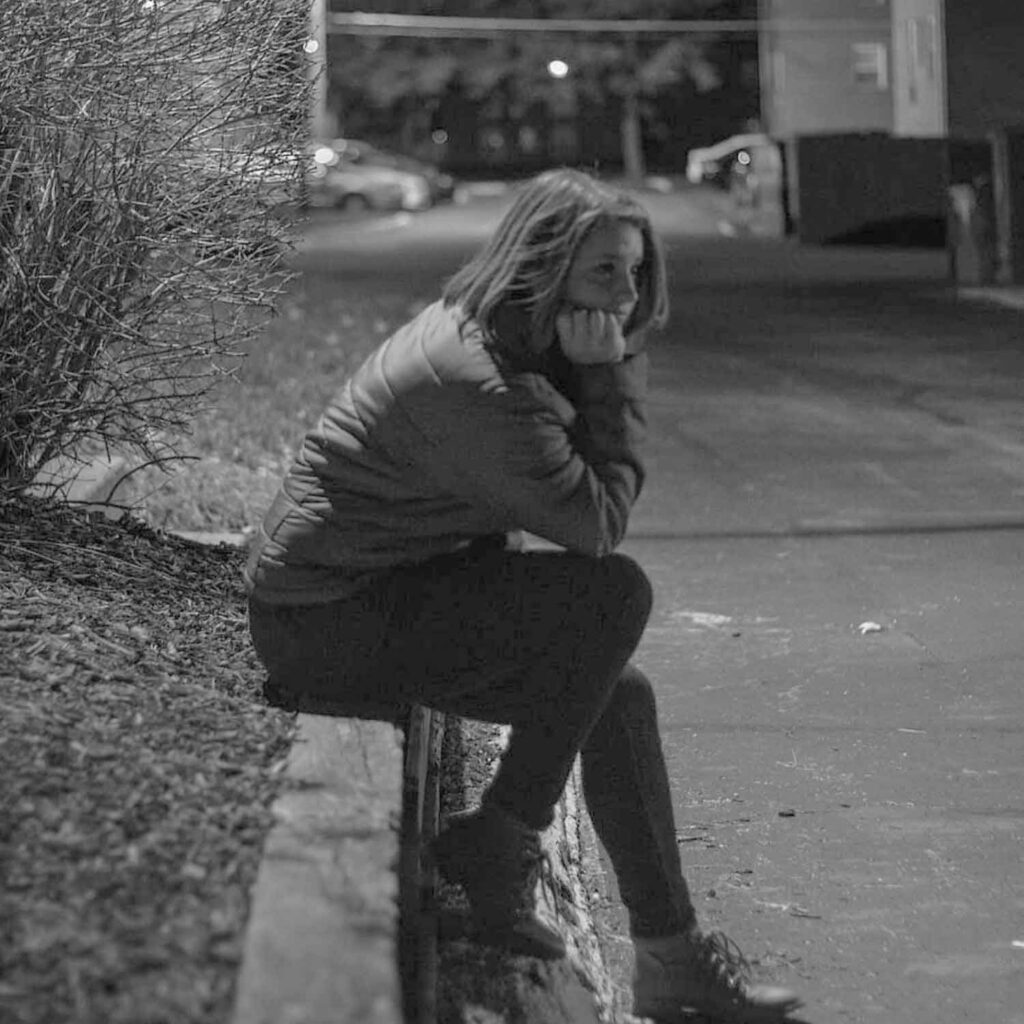
In the early evening, separation began to set in as I watched car after car speed by. From the sidewalk, I was unseen. But I could clearly see the purpose and intention on the drivers’ faces. They had somewhere to go, and likely, someone to connect with when they got there. In contrast, I was merely wandering alone in the wet, cold wind. I was invisible to people who passed by, busy with their lives going to comfortable homes, restaurants, or the grocery store to pick up dinner. No one was unkind – but no one made eye contact. I saw firsthand how easy it is to look past someone who is disconnected from society.
As darkness fell, the world changed. The night outside feels different than at home. Sounds are louder. Every movement around you makes you more alert. It is impossible to fully relax. You stay aware and on guard. While I was not afraid, it was unsettling and I began to understand why our homeless neighbors say they rest with one eye open at night and can only sleep during the day when the public is around to provide a measure of protection.
As the cold deepened, my feet and fingers began to ache and feel numb. I kept moving and came upon an elderly lady sitting in the doorway of an abandoned building. I spoke to her and gave her the blanket I had wrapped around my shoulders. I wondered to myself, “If this was my only blanket, would I have done the same and given it away?” That reality struck hard.
Once I stopped walking, the cold began to settle into my body. I thought about our clients at Jimmie Hale who have faced this type of cold and isolation – not for a single night, but for weeks, months, and even years before they entered our programs. I thought about the numerous individuals out there who still have nowhere to go. The mothers, the elderly, the ones battling addiction or mental health issues that could strike any of us. I thought a lot about the ones who may have given up in despair. My experience changed my perspective about others’ reality.
After volunteering and working with Jimmie Hale Mission for over 30 years, I personally experienced how homelessness is not just about the physical need for food and shelter, but about being exposed, uncertain, and disconnected from community. Even though I knew it was a temporary situation, I felt the loneliness of the night. It was a sense of being separated from the rest of the world. In the darkness, I prayed for the homeless and hurting and also for our Jimmie Hale clients who were finding hope for the first time in a long time. I prayed for our leaders.
When the morning finally came, I was tired, stiff, and deep in thought. Our work is not just helpful, it is crucial. Our purpose is not just to be busy in activities, but to provide real solutions and results for our most vulnerable neighbors and for our community, as a whole. A safe bed is not a luxury, a warm meal is not an exception, a pair of dry socks is not small. Sometimes these things are the difference between life and death.
Jimmie Hale Mission serves between 150 and 180 men, women and children every day of the year in our residential programs. Additionally, Jimmie Hale serves as the area warming station on the coldest nights of the year, providing 589 individuals refuge from the cold this Winter alone. To provide a year-round, low barrier onramp for our homeless neighbors to begin the path out of homelessness, Jimmie Hale plans to build a new year-round Emergency Plus Shelter. This facility will serve as the service hub where life change begins. A welcoming place where, beyond a safe bed and warm meal, our neighbors who need a hand-up can find a clean restroom, take a shower and wash clothes. Where they can receive basic medical, mental health, and emergency dental care. And where, though case management and relationship building, we can serve as a pathway to resources and long-term programs, both ours and others, that best provides the tools that each individual needs to return to being a healthy, productive member of the community. There is reason in why we work for funding, for recovery, for a hand up, and for second chances. Because in every life, there is hope.